Social media rewards what your brain can’t ignore.
Watson et al.’s 2024 study at Cambridge, published in Scientific Reports, analysed 95,000 articles alongside 579 million social media posts and found that users are 1.91 times more likely to share negative content than positive content. Not because people are gullible. Because our pattern recognition evolved to prioritise threats over reassurance, and no amount of media literacy changes the wiring. The algorithm didn’t create that bias. It just learned to use it faster than you learned to notice it.
That’s not a reason to avoid social media. It’s a reason to understand what you’re actually competing inside.
The game you’re playing (whether you know it or not)
Posting for attention is not the problem. Attention is the economy. If you’re building a brand, running a business, or trying to be heard in a market full of noise, understanding what drives engagement isn’t optional. It’s a core competency. The problem starts when getting attention becomes the strategy rather than a tool inside one.
There’s a line where optimising for engagement starts working against the authority and trust you need for that engagement to actually convert into anything. That line is different for every audience, every platform, and every positioning. But if you don’t know where yours is, you’ve already crossed it.
Before posting anything, four questions worth asking:
- Would my best client share this? (Trust test)
- Does this require outrage or exaggeration to work? (Engagement trap test)
- Can I back every point with epistemic truth, or am I stretching? (Credibility test)
- Why am I actually putting this out there? (Intent test)
If the answer to #2 is yes and #1 is no, you’re optimising for the algorithm at the expense of your business. If #3 makes you uncomfortable, the content isn’t ready. And if you can’t answer #4 with something more specific than "visibility," the piece has no strategic function.
What the algorithm actually does
Contrary to a popular narrative, social media algorithms don’t manipulate you directly. They observe what you respond to and serve you more of it. The platforms’ goal is straightforward: maximise the time you spend on the platform because more attention time means more room for ads. That’s the entire business model.
A landmark field experiment from the University of Warwick, University of Chicago, and Columbia University, published in February 2025, is the first causal proof of how this plays out. They gave 742 volunteers a browser plug-in that filtered toxic content in real time across Facebook, YouTube, and Twitter over six weeks. When toxic content was removed, active time on Facebook fell by 9%, YouTube by 7%, and ad clicks dropped by 27%. Toxic posts increased the likelihood of users clicking into comment sections by 18%.
The researchers put it precisely: platforms’ private incentives to curtail toxicity are not aligned with social needs. Toxicity isn’t a bug in the system. It’s a feature of the engagement model.
A 2025 peer-reviewed study in PNAS Nexus by researchers at Cornell Tech, UC Berkeley, and the University of Washington went further. They ran a preregistered algorithmic audit of Twitter and found that, compared to a simple reverse-chronological feed, the engagement-based algorithm amplified angry content by 0.47 standard deviations and partisan content by 0.24 standard deviations. The critical finding: users were less likely to say they preferred the political content the algorithm selected for them (-0.18 SD lower stated preference). People engage with content they don’t actually want to see. That structural divorce between what captures attention and what people value is the mechanism that makes the engagement trap work.
| Measure | Effect |
|---|---|
| Algorithmic amplification of angry content | +0.47 SD |
| User stated preference for that content | -0.18 SD |
This is older than the internet
None of this is new. Entertainment has existed for thousands of years. We are social beings, and anyone who understood how to get and maintain the attention of a group had an advantage. Historically, that’s how leaderships were formed, how civilisations rose and fell. Gutenberg accelerated it. Radio amplified it. Television industrialised it. Social media made it accessible to anyone with a phone.
The UK tabloid industry is the clearest historical parallel. Tabloids consistently outperformed broadsheets on engagement metrics for decades but suffered permanent credibility deficits in their core commercial audiences. The feedback loop Watson et al. describe (journalist writes negative, sharing rises, algorithm rewards, more negative content follows) is structurally identical to what the yellow press industrialised in the 1890s. The medium changed. The incentive structure didn’t.
The game theory underneath
This is where it gets structurally interesting. A 2024 thesis from the University of New Mexico formally modelled social media creator dynamics as a potential game with at least one Nash equilibrium. In practical terms, when every creator individually and rationally pursues maximum engagement, they converge on the same strategy: more provocation, more conflict framing, more emotional triggers. Individually logical, but collectively it erodes the credibility pool that makes any of their content commercially valuable. It’s a textbook prisoner’s dilemma.
A 2025 arXiv paper by Khadka et al. formalised the creator-algorithm dynamic as a Stackelberg game, where the algorithm acts as the leader setting exposure rules and creators are the followers optimising content within those rules. Different algorithmic priorities (click-through rate vs. watch time vs. social sharing) push creators toward conflict-based content as the equilibrium strategy. The model shows this isn’t a character failure. It’s a rational response to the incentive structure.
The creators who recognise this and deliberately choose a different equilibrium point, where attention serves trust rather than replacing it, are the ones playing a longer and more profitable game.
| Pure engagement play | Strategic sweet spot | Pure trust play |
|---|---|---|
| High reach, low trust, short decay | Attention that compounds authority | Low reach, high trust, slow compound |
The commercial cost of getting this wrong
Edelman’s 2025 Trust Barometer Special Report found that 88% of consumers now say trust is as important as price and quality when choosing brands. That’s not a soft metric. That’s a commercial filter. And 62% of respondents said they want brands to provide optimism and possibility, which structurally disadvantages content strategies that trade on conflict, anxiety, or outrage.
The 2026 Edelman Trust Barometer, drawn from 34,000 respondents across 28 countries, identified the next phase: people are retreating into insular circles of trust. Seven in ten respondents are hesitant or unwilling to trust those who differ from them in values or background. Trust is no longer flowing outward to institutions or celebrity-level creators. It’s flowing inward, toward smaller communities and voices that feel familiar and values-aligned.
For brands and personal brands, this means broad-reach engagement plays are losing their grip. Earned credibility within specific communities is gaining commercial weight. The question is not how many people saw your post. It’s whether the right twelve people trusted it enough to act on it.
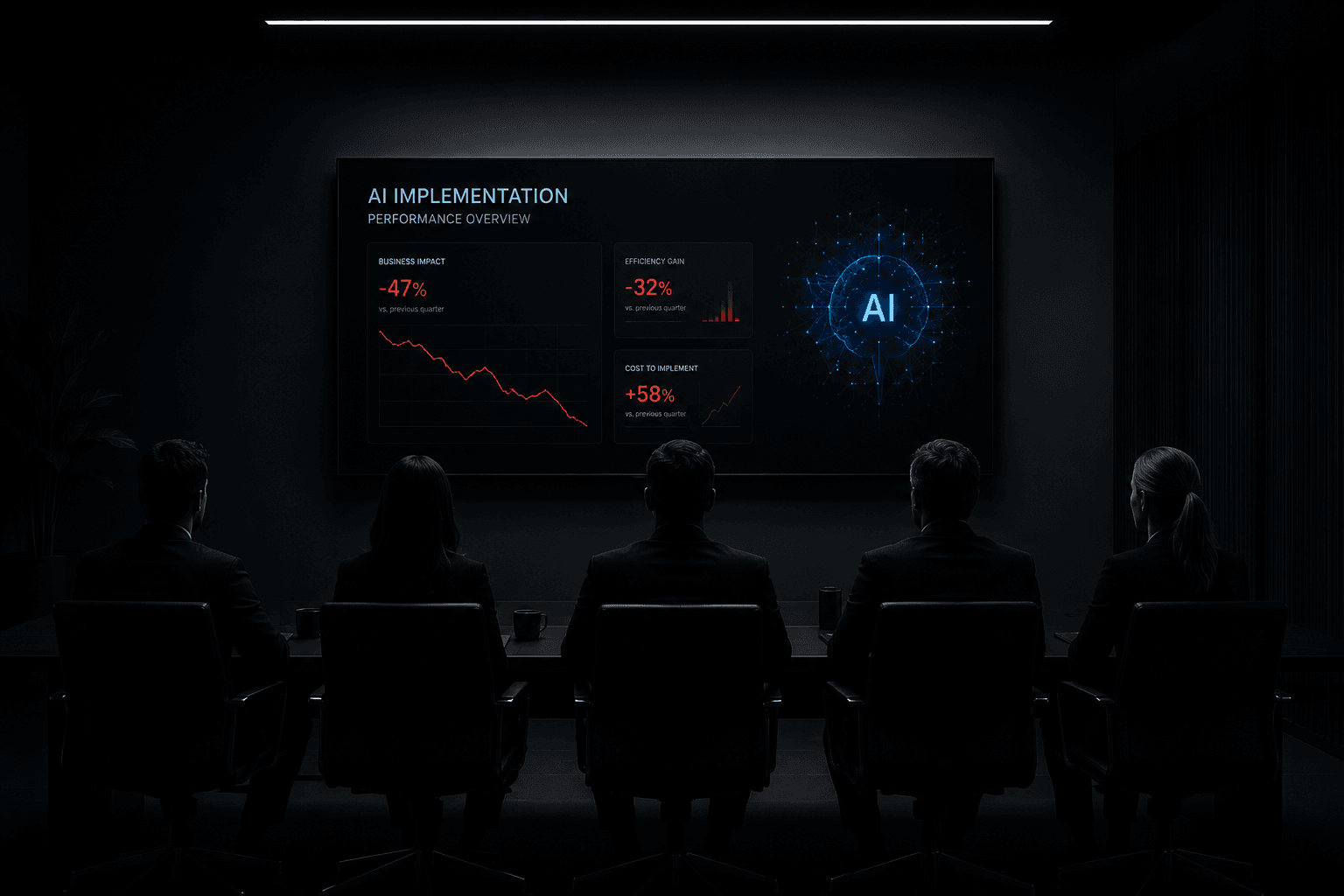
A WARC report from early 2025, later cited in Campaign Asia, quantified the cost of ignoring this: moving to a performance-only model (which is the content equivalent of optimising purely for engagement) causes a median revenue ROI decrease of 40%. The logic compounds. You harvest existing demand from the 15-25% of customers ready to buy now, but without trust-building to create new demand, acquisition costs escalate until the model collapses.
| Trust source | Trust level |
|---|---|
| Friends and family | 84% |
| Customers like themselves | 80% |
| Customer reviews | 68% |
| Brand employees | 63% |
| Journalists | 59% |
| CEOs | 58% |
| Influencers | 58% |
The nuance that most content about this topic ignores
Optimising for engagement is not inherently wrong. Attention is a prerequisite for everything else. You can’t build trust with people who haven’t noticed you exist. The skill is in understanding where the line sits for your specific audience, and that requires knowing your audience with enough precision to make the call.
There are genuine cases where engagement and trust align. LinkedIn’s algorithm, as of 2025, actively penalises engagement bait while rewarding content that demonstrates teaching ability. On that platform, expertise-sharing content can generate both high engagement and trust accumulation simultaneously. Instagram’s 2025 algorithm updates shifted distribution signals toward watch time, DM shares, and likes per reach, with DM shares requiring active, deliberate endorsement. That’s a stronger proxy for trust than raw engagement counts.
The answer isn’t to reject the attention game. It’s to play it with your eyes open, knowing that the platform’s incentive structure and your business’s incentive structure are not the same thing, and designing your content to serve both where possible and to prioritise trust where they conflict.
The smallest shift that changes the most
Before you post, ask: "Am I framing this to get a reaction, or to be useful?" If the honest answer is reaction, rewrite the hook. Not because reactions are bad, but because a hook that requires exaggeration to work is one that trades your future credibility for today’s metrics. The compound interest works in both directions.