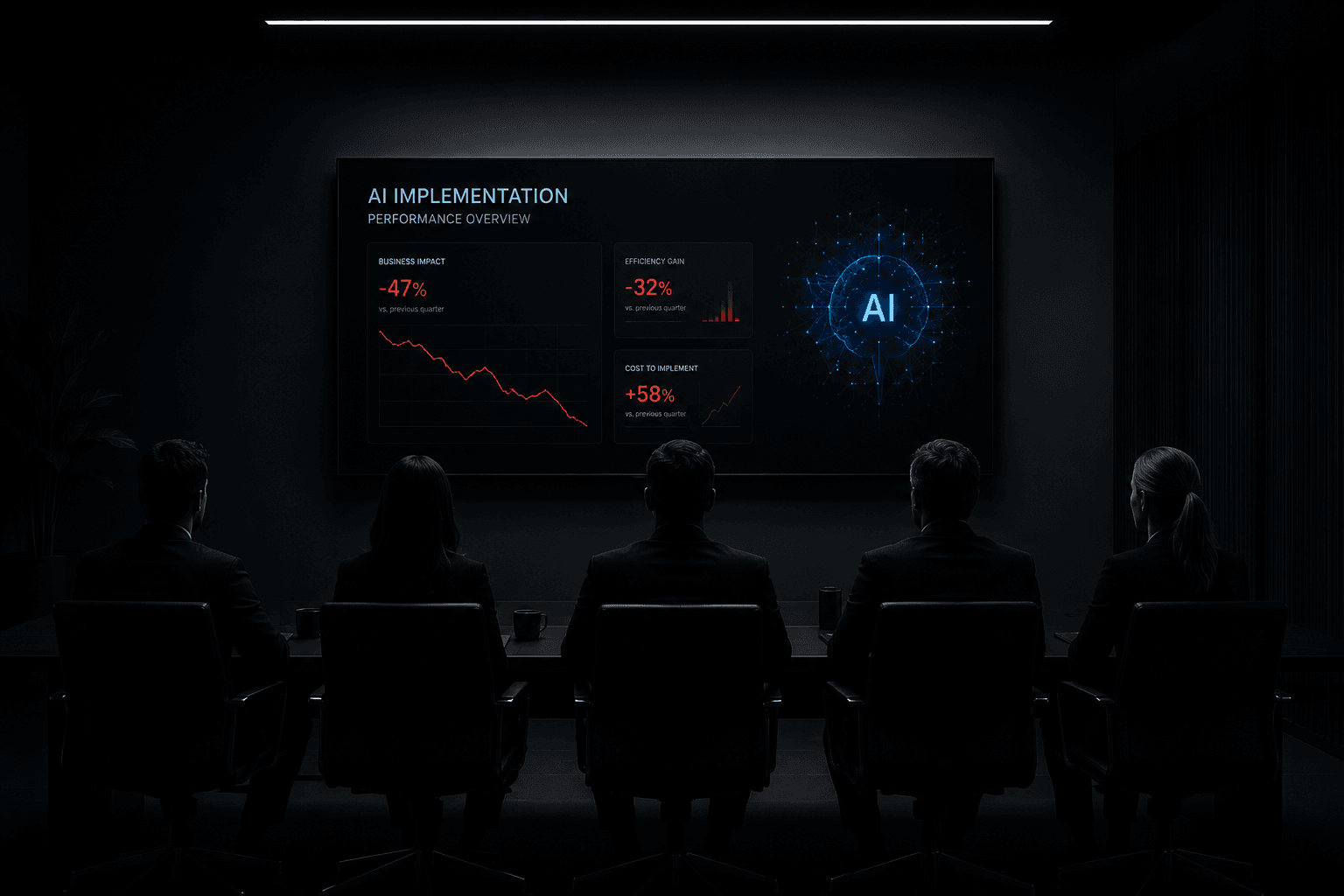
Every wave of technology cuts the cost of producing content. The internet collapsed distribution, smartphones collapsed production, and AI has now collapsed both at once. For the first time the output is visible in the data. Graphite’s May 2026 analysis of 55,400 English-language articles, using three separate AI detectors, estimates that primarily AI-generated articles have held near half of newly published articles since early 2025.
More content is competing for the same finite human attention. And here is the part that should reorganise how you spend: the price of buying that attention just stopped climbing.
WordStream and LocaliQ’s 2026 benchmark, covering 13,474 search campaigns from April 2025 to March 2026, found metrics broadly stable year on year and average cost per lead falling for the first time in five years. The reason is the useful bit. Conversion rates improved in 87% of industries. Costs held because advertisers, helped by better platform automation, converted more of the traffic they paid for.
That is the whole argument in one line. The binding constraint has moved from how much attention you can buy to how well you convert what you buy. For most small businesses, the highest-leverage work now sits after the click, in conversion rate optimisation and deliberate customer journey engineering, done before the next media budget gets approved. What follows is the evidence, the trade-offs, and the exact conversation to have with whoever runs your marketing.
The cost of making noise collapsed
Thirty years ago, reaching an audience meant television, print or radio. Production was expensive, placement was expensive, and the field was small. Holding attention was hard, but the competition for it was thin.
Then the curve bent. YouTube’s own disclosures track it: 6 hours of video uploaded per minute in 2007, 35 by 2010, 400 by 2015, and more than 500 by its 2019 and 2021 figures. The platform now frames its scale as more than 20 million videos uploaded a day. Anyone with a smartphone carries a decent camera, a decent microphone and free global distribution.
AI removed the last constraint, which was the time it takes a human to write, design or edit. Pangram Labs scanned over a million social posts that its browser-extension users encountered and reported on 9 July 2026 that more than 40% of the long-form LinkedIn posts in that dataset were flagged as fully AI-generated, with LinkedIn supplying 62% of all the AI content it detected across five platforms. That is an opt-in sample, not a random one, and AI detectors are probabilistic, so hold the exact figure loosely. Across independent studies using different methods, though, the direction is consistent. Machine output is now a large share of what competes for your customer’s eyes.
A word on attention itself, because the popular stat is wrong. The 8-second goldfish figure has no scientific source. What Gloria Mark’s team at UC Irvine actually measured is how long people stay on one screen before switching: roughly two and a half minutes in 2004, down to about 47 seconds in recent years, replicated by other labs. That describes fragmented screen behaviour, not a shrinking brain. You are not fighting for a smaller resource, you are fighting cheap dopamine for a pickier one.
The platforms did not get cheaper. They got better at converting.
It would be easy to read “costs stabilised” as good news and stop there. Look closer at what stabilised them.
Over ten years, search ad costs roughly doubled. WordStream’s average cost per click went from $2.32 in 2016 to $5.42 in 2026, and Google conceded during its antitrust trial that it had raised search ad prices to hit revenue targets. Auction pricing turns demand into a price, and demand kept climbing. What changed in the last year is the other side of the equation. Conversion rates rose across most industries, so cost per lead fell even though clicks did not get cheaper.
Meta shows the same pattern from the other direction. Its Q1 2026 filing reports average price per ad up 12% year on year while ad impressions grew 19%. That figure is blended ad revenue divided by impressions, not a clean read on any single advertiser’s CPC, and Meta attributes it to advertiser demand, better targeting and measurement, and a currency tailwind. The platform is monetising better because it converts better.
The honest caveat: the content flood and the ad economics are two true facts running in parallel. I am not claiming AI content volume caused ad prices to move. The mechanism is plausible, but it is not established, and you do not need it. The load-bearing fact stands on its own. Whatever sets the price of a click, the return on that click is now decided almost entirely by what happens after it.
Volume is a big-company game
Scale changes the economics of attention. Past a certain threshold of activity, awareness compounds. People who saw the brand last month search for it this month, brand search converts cheaply, and the system feeds itself. A big brand can absorb inefficiency that would sink a small one, because volume papers over waste.
Below that threshold, the waste is brutal. WordStream’s analysis of more than 15,000 Google Ads accounts found that around 29% recorded zero tracked conversions over 90 days. Some of those almost certainly had broken or absent conversion tracking rather than genuinely zero sales, which is arguably worse: they were buying attention and flying blind on what it produced. Either way, a bigger budget does not fix that. It scales it.
The same AI that flooded the feed also cut the cost of fixing your funnel
This is the part most commentary misses. AI collapsed the cost of two very different activities, and almost everyone piled into the first.
Content production is now commoditised. That is why roughly half the web is machine-written, and it is also why volume alone underperforms. Graphite’s companion study found that around 86% of top-ranking Google pages are still human-written. Graphite is careful to note that ranking depends on many hidden variables, so treat that as a strong association rather than proof. The pattern is hard to ignore: producing more AI content is not translating into more visibility.
Journey engineering is the second activity, and it is nowhere near commoditised. It covers mapping the path from click to sale, building and testing landing pages, removing friction, and tightening follow-up. Work that used to need a designer, a developer and a copywriter can now largely be handled by one competent marketer with current tools. My read, from doing this work, is that one good operator covers around 80% of that old output in a fraction of the time and cost. To be clear about the limit, a £20-a-month AI subscription does not replace a marketing team. It means a well-equipped team, or freelancer, ships far more per hour than the same person could in 2022.
The arbitrage sits in plain sight. Most businesses are using AI to make more noise. Few are using it to convert the attention they already pay for. Relevance is non-negotiable. Added value is non-negotiable. Removing mechanical and cognitive friction is non-negotiable. All three are cheaper to deliver than they have ever been.
The pre-budget journey audit
Before approving next quarter’s paid media budget, sit down with your marketer, freelancer or agency and answer three questions.
1. Where does attention leak? Walk the journey a real customer takes, click by click: ad to page, page to action, action to follow-up, follow-up to sale. Put a drop-off number on every step. If nobody can produce those numbers, that is finding number one.
2. What is the leak worth? Run the arithmetic before you run the budget.
| Option | Monthly spend | Conversion rate | Customers | Effective cost per customer |
|---|---|---|---|---|
| Buy 50% more traffic | £15,000 | 2% | 150 | £100 |
| Lift conversion | £10,000 | 3% | 150 | £67 |
A business spending £10,000 a month at a 2% conversion rate gets the same customer volume from buying 50% more traffic as it does from moving conversion to 3% at the same spend. Both still rely on auction-priced clicks. The difference is that Option A pays 50% more every month for the extra volume, while Option B’s improvement compounds on every future pound of spend at no recurring media cost. The comparison assumes CPC and traffic quality hold and ignores the cost of the conversion work, which is real but usually one-off.
3. Is the journey congruent? Does the page deliver exactly what the ad promised? Is the value obvious within seconds? What mechanical friction (forms, load time, steps) and cognitive friction (confusion, doubt, effort) can go this month?
The rule that makes this work: no media budget gets approved until all three questions have answers.
Where this advice breaks
Intellectual honesty requires the boundaries. If you have too little traffic, there is not enough data to learn from, so you need some volume first. Conversion work has diminishing returns; the structural fixes are cheap and large, and the gains after them get progressively more expensive. And none of this argues against brand or against paid media. Brand compounds and paid scales. The argument is about sequence. Engineer the journey, then buy attention for it, because buying attention for a broken journey is the most expensive way to learn it is broken.
The Monday action
Book one hour this week with whoever runs your marketing. Walk the customer journey end to end, live, on a phone. If you cannot name where attention leaks and what each leak costs, you are not ready to buy more of it. Costs stabilised this year because conversion improved. That is not a coincidence you can sit out. The businesses that win the next few years will not be the loudest, they will be the ones that convert the attention they already pay for.